Why Are Diamond Prices Falling?
Lab-grown diamonds changed what buyers can get for their money—and exposed the difference between a diamond’s emotional meaning and its financial value.
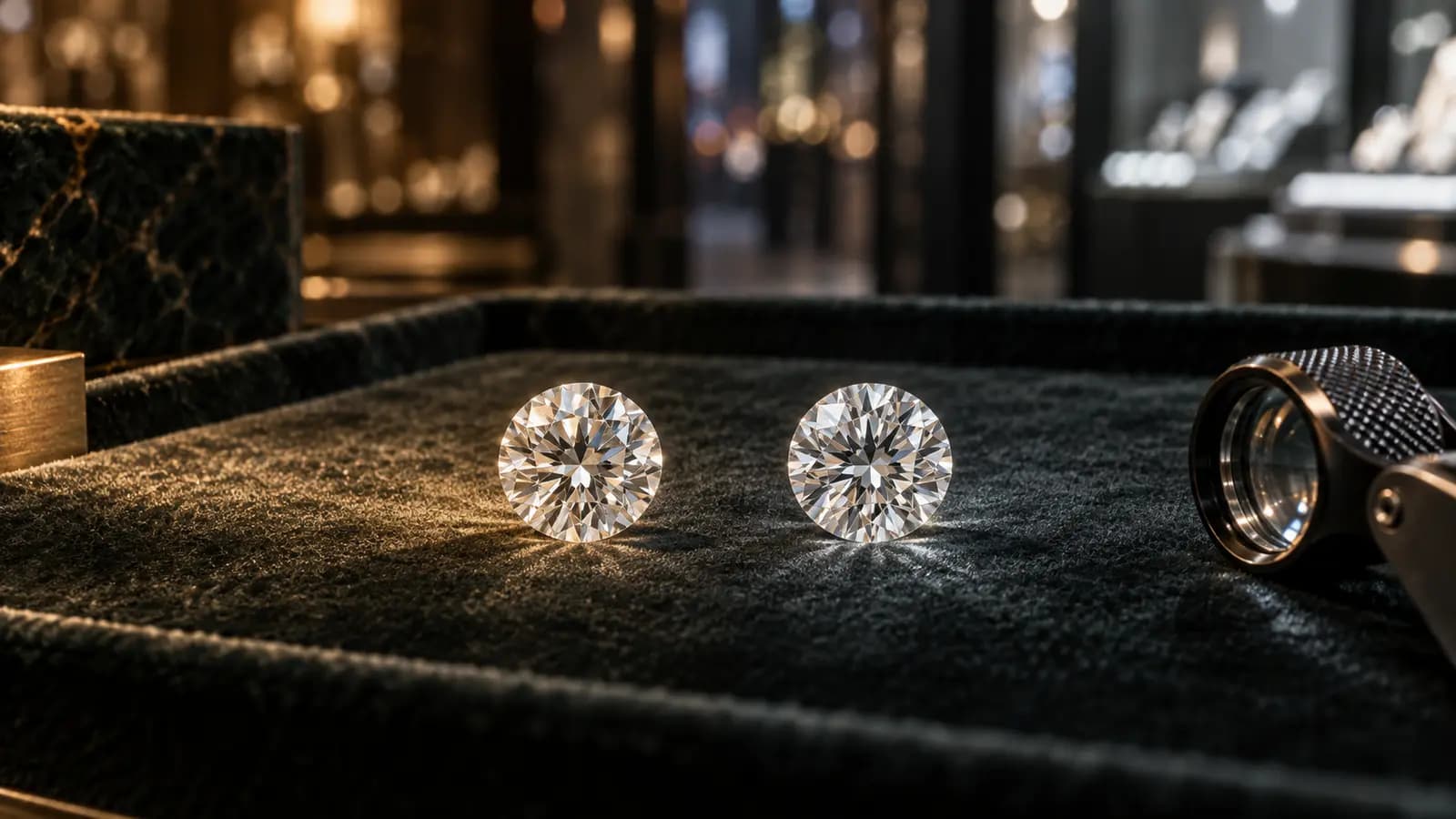
Walk through New York’s Diamond District and you will hear two conversations happening at once.
The first is the conversation jewelry has always inspired: love, status, beauty, commitment and the desire to own something that feels permanent.
The second is less romantic. It is about falling prices, weaker demand, lab-grown competition and what a stone might bring if its owner ever tries to sell it.
Those conversations now collide every time someone walks into a jewelry store.
A buyer may see two stones with similar sparkle and dramatically different prices. One formed underground; the other was grown in a controlled environment. Both are diamonds, but they do not arrive with the same history, supply constraints or resale market.
That distinction explains much of the disruption now moving through the industry.
Lab-grown diamonds are diamonds—not imitations
The first misconception to clear away is that a laboratory-grown diamond is merely a replica like cubic zirconia or moissanite.
It is not.
The Gemological Institute of America says lab-grown diamonds have essentially the same chemical, physical and optical properties as natural diamonds. Both are primarily carbon. Both can reach 10 on the Mohs hardness scale. Both can be cut to produce the brightness, fire and scintillation buyers associate with diamonds.
What differs is their origin.
Natural diamonds formed deep within the Earth over immense spans of geological time. Laboratory-grown diamonds are produced using high-pressure, high-temperature technology or chemical vapor deposition. The result can be so similar that specialized testing is needed to determine whether a stone was mined or manufactured.
That does not make origin irrelevant. The Federal Trade Commission requires sellers to clearly disclose when a diamond is laboratory-grown or laboratory-created so consumers do not mistake it for a mined stone.
GIA’s treatment reinforces the distinction. GIA began issuing reports for synthetic diamonds years ago, but as of October 2025 it evaluates eligible colorless-to-near-colorless lab-grown stones using the broader labels Premium and Standard, rather than applying the same grading terminology it developed for natural diamonds. Eligible stones are also laser-inscribed as laboratory-grown.
So the accurate description is not “fake diamond.” It is a real diamond produced through a different process and sold into a different market.
Technology broke the old price comparison
For generations, the natural-diamond business sold more than a gemstone. It sold scarcity, permanence and cultural meaning.
Lab-grown production changed the equation because manufacturers can add supply without discovering and developing a new mine. As the technology improves and production expands, comparable stones become less expensive to produce.
That has created an obvious proposition for buyers: if the purpose is appearance, celebration or the pleasure of wearing a larger stone, why pay the natural-diamond premium?
Many buyers decided they should not.
The result has been pressure on both sides of the market. Natural diamonds face competition from a visually comparable and much cheaper product. Lab-grown diamonds face relentless price pressure from their own expanding supply and declining production costs.
Industry analyst Edahn Golan reported that wholesale lab-grown diamond prices fell another 26 percent during 2025. By the second quarter of 2026, the wholesale index he tracks was down 96 percent from its 2018 starting point, although the rate of decline had begun to slow.
The natural market has also struggled. Anglo American reported that De Beers reduced rough-diamond production in 2025 in response to a prolonged period of lower demand. In the first half of 2026, the company reported that its average rough-diamond price index had fallen another 16 percent.
“The diamond market has crashed” captures the mood, but it is too broad to describe every stone. Diamonds do not have one universal price. Natural and lab-grown markets behave differently, and price performance varies by carat, cut, color, clarity, rarity and the point in the supply chain being measured.
What can be said plainly is that the old assumptions have broken down. A high retail price does not guarantee scarcity, and scarcity does not guarantee an easy resale.
Retail price is not resale value
This is where many consumers get hurt.
The price paid in a jewelry store includes far more than the wholesale value of the loose stone. It may include the setting, design work, brand, store overhead, sales commission, financing costs and retail markup. When the customer returns to sell, the buyer is not refunding those expenses. The buyer is pricing the material they believe they can resell at a profit.
That gap exists with natural diamonds too. A grading report documents characteristics; it does not promise a future price. A larger or unusually rare natural stone may attract a stronger market than a common commercial stone, but “three carats and above” should not be treated as an automatic investment rule. Size alone cannot create liquidity, rarity or buyer demand.
Lab-grown stones face an additional problem: a dealer considering a used lab-grown diamond is competing with newly manufactured stones whose wholesale prices may be lower tomorrow. That makes repurchase offers particularly weak or, in some cases, nonexistent.
The exact resale percentage depends on the stone and the buyer. Claims that a particular $7,000 purchase will always resell for $500—or that a natural stone will predictably return $5,500—cannot be guaranteed. What matters is the principle beneath those examples: retail price and cash-out value are two different numbers.
If you cannot explain who is likely to buy the stone from you, how they will price it and how quickly the transaction can happen, you do not have an investment thesis. You have a hope.
What should you buy?
Start with the purpose of the purchase.
If you want beauty for the budget
A lab-grown diamond can provide the look and physical properties of a diamond at a substantially lower initial price. Treat it as a consumer purchase, not a store of value. Assume resale proceeds could be minimal and decide whether the enjoyment is worth the price on that basis.
If natural origin matters to you
A natural diamond offers geological origin, constrained mine supply and a more established secondary market. None of those guarantees appreciation. Compare stones carefully, insist on an independent grading report and remember that the retail markup may never be recovered.
If you want an investment
Ordinary diamond jewelry is usually a poor substitute for an asset with transparent pricing and a deep, liquid market. Exceptional natural diamonds can have collector value, but that is a specialized business requiring expertise, sourcing relationships, authentication and access to buyers. It is not created simply by crossing a carat threshold.
Buy with the exit in mind
One of the sharpest observations from the Diamond District is that money is made when you purchase.
That does not mean every diamond should be bought for resale. It means overpaying creates a loss before the owner ever leaves the store.
Before buying, ask:
- Is this natural, laboratory-grown or a simulant?
- Is the origin and any treatment recorded in writing?
- Which independent laboratory issued the report?
- What comparable loose stones sell for elsewhere?
- Does the seller offer a written trade-in or buyback policy?
- What portion of the price comes from the stone, setting, brand and financing?
- Would I still want this if its resale value fell sharply?
The FTC advises buyers to ensure that important representations—including origin, weight, treatments and special-care requirements—appear in the sales paperwork. If a seller will not put those details in writing, that is useful information in itself.
Meaning and market value are not the same thing
A wedding ring can become priceless to the people who wear it while remaining a poor financial asset. There is no contradiction in that.
The mistake is allowing emotional meaning to substitute for financial analysis—or allowing a salesperson to imply that a grading report turns a retail purchase into an investment.
Lab-grown diamonds did not eliminate the meaning of natural diamonds. They did something more disruptive: they gave consumers another way to buy the appearance and durability of a diamond, then forced the entire industry to defend the premium attached to origin and scarcity.
That is why diamond prices are falling, and why the best purchase depends on what you actually expect the stone to do.
Buy lab-grown for appearance and value at the time of purchase. Buy natural if origin, rarity and tradition justify the premium to you. Buy neither under the assumption that a jewelry-store receipt guarantees an investment return.
Because the price is what you pay. The value depends on what you are buying it for.
Sources and further reading
- GIA: Laboratory-grown diamond growth processes
- GIA: Laboratory-grown diamond services and identification
- GIA: Updated laboratory-grown assessment system
- Federal Trade Commission: Buying gemstones, diamonds and pearls
- Federal Trade Commission: Diamond advertising and disclosure
- Anglo American: Q2 2025 production report
- Anglo American: 2026 half-year financial report
- Edahn Golan: Lab-grown diamond wholesale prices in 2025
This article is consumer education, not investment advice. Diamond prices and resale offers vary substantially by stone, seller and market conditions.